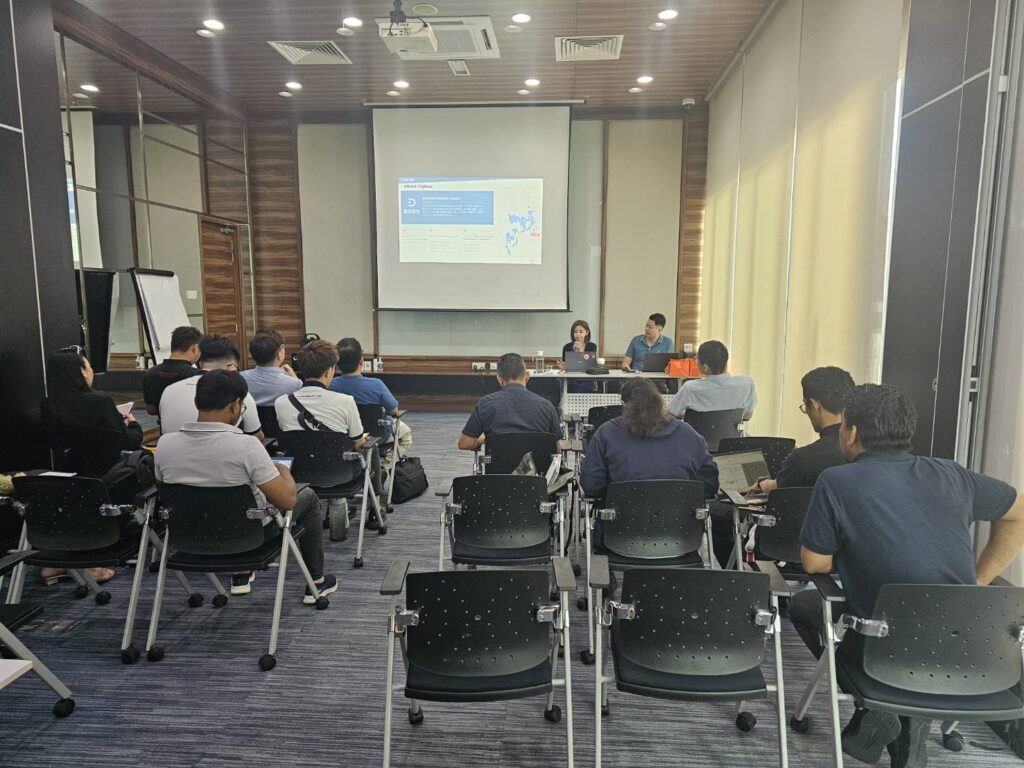


Intelligent Asia Thailand 2026 concluded successfully today. Throughout the three-day exhibition, DigiHua Intelligent showcased its core strategy of “Data Foundation + AI Agent,” assisting electronics and semiconductor enterprises in building resilient competitive cores within an uncertain global environment .
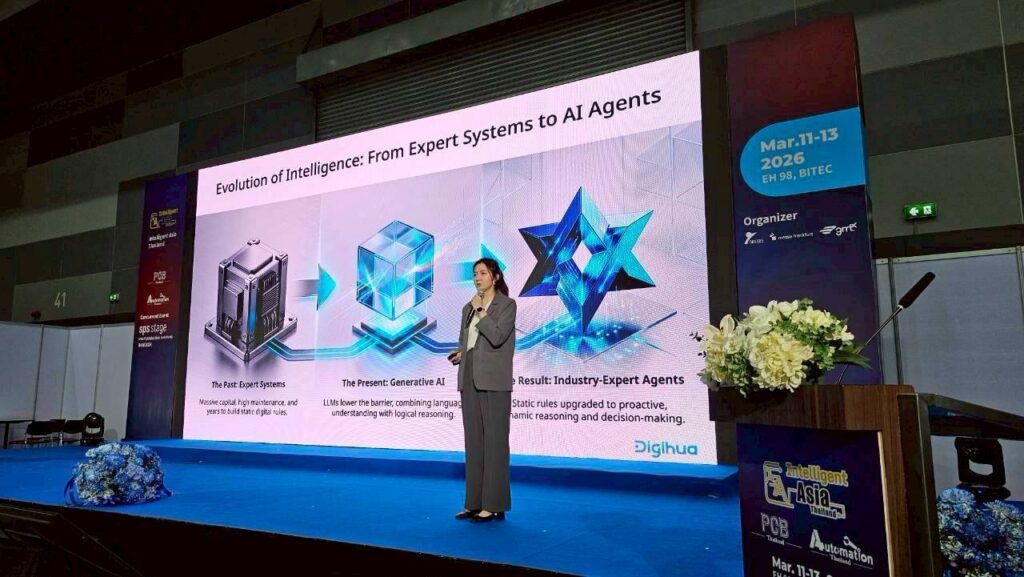
DigiHua Intelligent Drives the Evolution from Expert Systems to AI Agents
Facing challenges of labor shortages and experience retention in manufacturing, DigiHua presented its R&D achievements in transitioning from traditional “Expert Systems” to “AI Agents” . Past systems involved high implementation costs and rigid rules, requiring years to establish static digital logic—making it difficult to respond to the rapid fluctuations of today’s semiconductor industry . By leveraging Generative AI, DigiHua has encapsulated over 30 years of industry knowledge into Industry-Expert Agents capable of language understanding and logical reasoning. The core operation consists of three critical layers:
- Database Agent: Directly converts natural language into SQL database queries, enabling production managers without programming backgrounds to perform precise data analysis and significantly lowering operational barriers.
- Reporting Agent: Automatically executes multi-dimensional analysis and generates visual charts, helping supervisors quickly identify anomalies within complex production data.
- Operational Agent: Features proactive learning mechanisms that combine user focus areas to push critical alerts and progress tracking, achieving a shift from “people seeking data” to “data seeking people”.
AI Agent Industry Knowledge Encapsulation Process (RAG Technology):
- Knowledge Ingestion: Proprietary SOPs, machine maintenance manuals, and historical production data are vectorized and stored to create a secure internal knowledge base .
- Intelligent Retrieval: When a user asks “Why is capacity low?”, the system utilizes the industry-encapsulated Data Foundation to precisely retrieve relevant industry data, historical context, and resolution processes.
- Precise Generation: Retrieved data is integrated with modern LLMs (such as DeepSeek or OpenAI) to generate actionable decision-making recommendations with professional reference value.
This innovation allows the system to proactively understand complex production contexts, bridging the gap from data accumulation to active decision-making and providing real-time intellectual support for manufacturers.
Encapsulated Industry Logic in Data Foundations: The Key Moat for Semiconductor AI Transformation
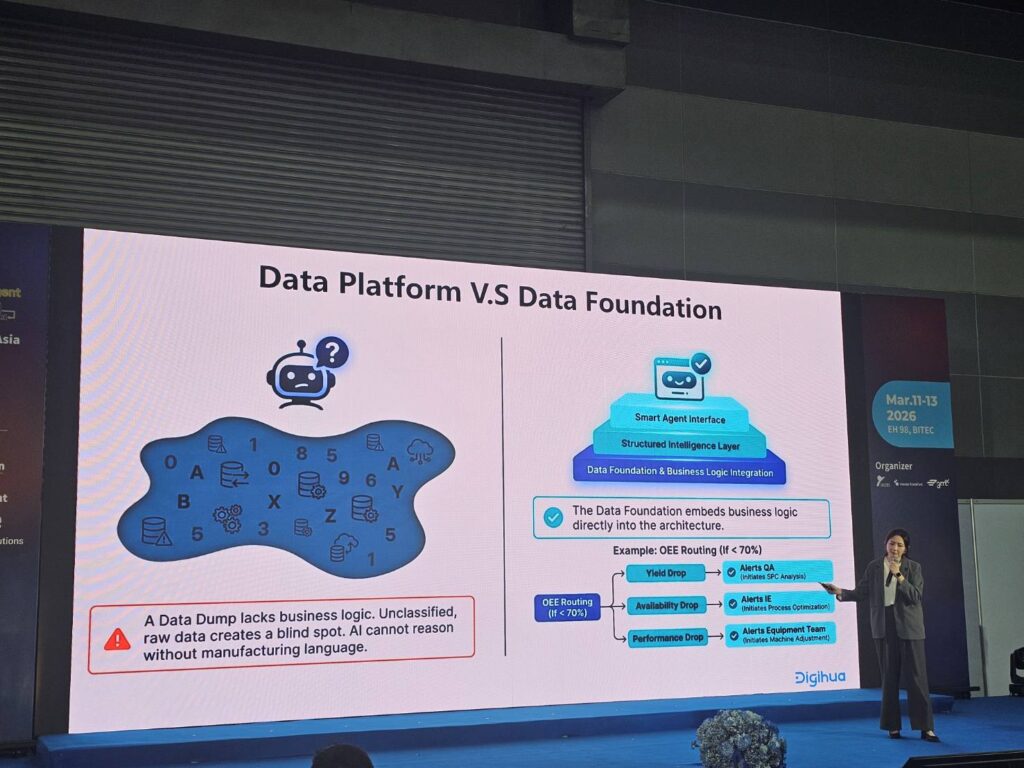
DigiHua clearly states that the actual benefits of AI depend on the architecture of the “Data Foundation” rather than a mere “Data Dump” . A true Data Foundation must deeply encapsulate industry management logic, especially for the semiconductor industry and high-precision electronics manufacturing where processes are extremely precise and tolerance for error is low . Unlike traditional data warehouses, which are unclassified collections of big data, DigiHua’s Data Foundation achieves structured integration across three domains:
- Design (CAD/PLM): The source of truth containing all product specifications and technical parameters.
- Plan (ERP/APS): The operational brain controlling procurement rhythms and production scheduling.
- Execution (MES/EAP): Captures real-time data from the shop floor regarding Man, Machine, Material, Method, and Environment (5M).
Encapsulated Logic (Example: OEE Anomaly Auto-Trigger Mechanism):
The Data Foundation encapsulates management logic for Overall Equipment Effectiveness (OEE). For instance, if OEE falls below 70%, the system automatically initiates decision routing based on preset industry logic to ensure the stability of high-precision processes:
- Yield Drop Determination: If the primary cause is yield, the system automatically triggers and notifies Quality Assurance (QA) to initiate SPC (Statistical Process Control) analysis.
- Utilization Drop Determination: If the cause is low utilization, it immediately notifies Industrial Engineering (IE) to initiate process optimization and WIP (Work-in-Process) control.
- Performance Drop Determination: If performance degradation is identified, the system alerts the Equipment team to perform machine adjustments or “最適 Recipe” checks.
This synergy of structured data and automated processes allows AI Agents to read meaningful information through the Data Foundation in the shortest time possible, serving as the most robust strategic cornerstone for AI transformation in the semiconductor and electronics industries.
Agile Productivity Solutions Assist Electronics and Semiconductor Supply Chains in Responding to Global Market Volatility
Addressing the shift from “Steady-State” to “Agile” productivity in global supply chains, DigiHua demonstrated its highly flexible MOM (Manufacturing Operations Management) smart factory solutions . In SMT and precision electronics lines, full-process intelligent monitoring—including auxiliary material control, automated error-proofing for loading, and single-board level traceability—is achieved through IIoT/EAP technology . When the semiconductor industry faces capacity gaps or material shortages, APS+AI provides real-time alternative resource adjustments and priority simulations, allowing rapid decision execution through a natural language interface to achieve optimal delivery times and production balance .
Assisting Multinational Corporations in Rapidly Replicating Successful Management Through System-Led Strategies
Amidst the wave of global multi-site deployment, DigiHua advocates for “System-Led Implementation” to replace the traditional “Human-Led Task Force” . By encapsulating operational strategies and 5M standards into IT tools, DigiHua assists enterprises in new overseas regions—such as Thailand, Malaysia, and Vietnam—to rapidly align with headquarters’ management models and integrate local supply chains . This transformation path, anchored by the Data Foundation, not only reduces the “pain index” of system implementation but also ensures that enterprises can continuously iterate and upgrade toward an AI-driven operational model within the “deep waters” of digital transformation.