
1. What is SMT?
From Lego Bricks to Precision Automation
If you are looking to step into the Surface Mount Technology (SMT) industry but feel a bit overwhelmed, don’t worry—let’s set aside complex electronic diagrams and advanced machinery for a moment. Think back to playing with Lego bricks as a child: you take small plastic blocks of various shapes and colors and stack them one by one onto a baseplate to build a castle or a race car.
Modern electronic products, like the smartphone you use every day, are essentially miniaturized “Lego castles.” And SMT (Surface Mount Technology) acts as the core and most critical “automated assembly” master craftsman behind building it.
Looking at traditional assembly technologies like DIP (Dual In-line Package) through-hole technology, electronic components feature long pins that must pass through holes at the bottom of the printed circuit board (PCB) before being soldered. The process feels like crafting by hand—threading a needle—which is slow and consumes significant space. However, with technological advancement, modern chips, capacitors, and resistors have shrunk to sizes nearly invisible to the naked eye. Can you imagine still using manual or traditional through-hole methods for installation? Doing so would not only fail to shrink product dimensions, but production speeds would also completely fail to keep pace with market demands.
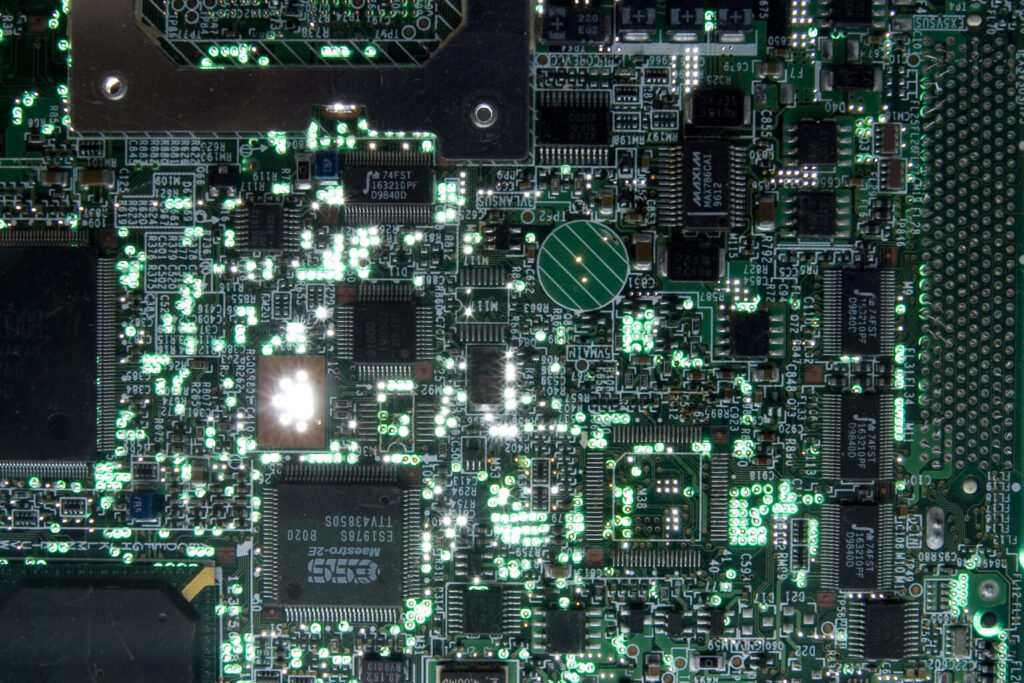
In contrast, SMT eliminates the need for components to “pass through holes,” mounting them directly onto the PCB surface instead. That’s right—what used to be a tedious, needle-threading engineering task has become as simple as applying a sticker! Driven by high-precision automated machinery, robotic arms place tens of thousands of miniature electronic components per second precisely onto pre-solder-pasted locations on the PCB, culminating in instantaneous connection via a high-temperature reflow soldering oven.
For modern manufacturing, SMT is a flowing lifeline. From the Bluetooth earbuds and wearable devices you use daily to the factory automation equipment around you, the green circuit boards inside are almost entirely products of SMT. It endows electronic products with a “light, thin, short, and small” soul while delivering increasingly powerful performance. Therefore, the next time you walk into a plant and hear the mechanical operational hum of an SMT line, picture it as a precise, ultra-fast, highly automated “miniaturized Lego factory.”
Where Are the Technical Pain Points on the Production Line?
Let’s break down the specific landscape of SMT across different dimensions, as every manufacturing professional’s experience with SMT varies significantly. Take a look at the categories below—which one resonates with you the most?
- By Application & Market: Transitioning from cost-effectiveness to ultimate stability, it is mainly divided into two categories:
- Consumer Electronics (e.g., smartphones, earphones, IoT): Characterized by short life cycles and high price sensitivity, where the keys to SMT are “speed” and “cost.” Production lines pursue high Overall Equipment Effectiveness (OEE) and rapid changeovers to handle diverse orders.
- Automotive & Industrial Control: Characterized by low error tolerance and strict environmental endurance requirements for SMT, demanding near-obsessive standards for “solder joint quality.” AOI standards and traceability serve as the core of these lines.
- By Timing & Environment: Transitioning from prototyping flexibility to mass production stability, divided into two categories:
- R&D Prototyping: Racing against time, where SMT focuses on “flexibility” and “rapid correction,” ensuring prototyping results can be flawlessly replicated in subsequent mass production.
- Mass Production: When production lines enter 24/7 continuous operation, SMT priorities shift to “stability” and “error-proofing.” Continuous component dropping or minor deviations in reflow temperature profiles can lead to thousands of scrapped units.
- By Functional Perspective: Divided into three primary roles:
- R&D Engineers (RD): Focus on “Design for Manufacturability (DFM).” If circuit design fails to account for pick-and-place machine nozzle clearance or component arrangement, it easily leads to frequent line jams or poor yields.
- Production Control (MC/PC): Focus on “Changeover Efficiency,” fearing nothing more than “downtime.” Every line changeover represents a loss of cost.
- Quality Engineers (QA/QC): Focus on “yield rates and solder cracking.” Facing tens of thousands of solder joints, they leverage data to uncover patterns behind solder cracking and cold solder joints.
2. The SMT Transformation in Manufacturing
After understanding the basics of SMT, we shift our perspective back to the actual manufacturing shop floor. Today’s production environments must align closely with market demands. Post-2025 markets exhibit intense pressure characterized by “High-Mix, Low-Volume” (HMLV) production, rendering production lines extremely sensitive.
From a management perspective, “complexity” and “volatility” are the two major pain points on SMT lines. The downtime caused by frequent changeovers, the tedious complexity of component traceability, and production capacity gaps driven by labor shortages continuously test managers’ adaptability. When operational technology (OT) data generated by equipment decouples from information technology (IT) scheduling at the management level, out-of-control quality and capacity waste become inevitable. This is the hidden risk lurking behind the scenes.
Currently, “how to maintain flexibility and yield rates in a highly volatile environment” is arguably the most critical focus for SMT in the manufacturing sector. According to industry insights, modern manufacturing has leveraged AI penetration to shift from traditional, experience-reliant “ex-post detection” to big-data-driven “proactive prevention.” Whether utilizing machine learning to optimize reflow temperature profiles or applying deep learning for automated optical inspection (AOI) defect classification, these approaches alleviate production pressure while striking a balance between pursuing efficiency and ensuring quality.
3. How SMT Drives Cost Reduction & Efficiency
“Quality is saved, and efficiency is seized.”
This mindset resonates across many manufacturing shop floors because we have long been accustomed to “reactive management.” We adjust machines only after components drop, check reflow temperature profiles only after yield anomalies occur, or discover frequent solder cracking only after receiving customer complaints post-shipment. All of these represent hidden costs.
Looking ahead, our approach to optimizing manufacturing lies in digitizing “SMT parameters.” By mastering various process data points, we can transform “passive remediation” into “proactive defense.” For instance, real-time monitoring of solder paste printing thickness and offset allows defects to be intercepted prior to component placement, preventing expensive downstream scrap. Utilizing intelligent scheduling to optimize changeover workflows minimizes equipment idle time waiting for materials. This journey—shifting from “gut feeling” decisions to “data-driven decision-making”—is the sole pathway to lowering component loss rates and boosting production capacity.
SMT Line Optimization: Before vs. After Comparison
| Aspect | Past (Reactive Management) | Future (Smart Predictive Management) | Key Value |
|---|---|---|---|
| Changeover Speed | Manual adjustments, prolonged downtime | System-assisted, rapid parameter switching | Reduces downtime hours, improves Overall Equipment Effectiveness (OEE) |
| Component Loss Control | Relies on manual patrols to discover anomalies | AI real-time monitoring of offsets and defects | Lowers material waste, saves material costs |
| Quality Inspection | Relies on manual visual re-inspection | Automated Optical Inspection (AOI) & AI defect classification | Enhances yields, mitigates rework and customer complaint risks |
| Process Parameters | Relies on engineers’ individual experience | Digital process traceability records | Shortens trial production time, ensures reproducible quality |
| Material Management | Expired materials discarded or stockouts occur | System early warnings and automated material requisition | Optimizes inventory turnover, reduces capital occupation |
4. SMT Moving Toward Smart Manufacturing
If your goal goes beyond simply “keeping the production line running” and aims toward “Smart Manufacturing,” we recommend transitioning step-by-step from “operation” to “observation.” We know that process optimization can solve immediate issues like solder cracking or component dropping, but the learning objective of Smart Manufacturing is to build the production line’s “digital perception capability.”
So, how do you learn to digitize SMT operations?
First, the entry point for learning lies in “data correlation.” This means we can no longer simply look at pick-and-place machine component loss reports; instead, we must understand why a machine’s component dropping rate increases at specific times and under specific temperatures. Next, try breaking down the log files generated by the pick-and-place machine, cross-referencing them with upstream solder paste printing thickness information, and even grasping the Machine-to-Machine (M2M) communication mechanisms between equipment.
The essence of Smart Manufacturing is empowering equipment with “self-diagnosis.” However, achieving this requires stitching fragmented data into a comprehensive production line history (traceability record). Consequently, your mindset must transform from a technical operator into a production line “digital architect.”
SMT Intelligent Manufacturing Learning Workflow
- Perception Layer: The goal is to master equipment parameters and key indicators (e.g., placement offset, component loss rate, reflow temperature profiles), learning to interpret every alarm and dataset thrown by the machine.
- Connectivity Layer: Establishes M2M networking, understanding how equipment communicates and triggers signals with one another, breaking down data silos, and allowing information to flow seamlessly across the line.
- Decision Layer: Introduces AI data analysis to achieve predictive maintenance and automated parameter optimization, enabling the production line to “automatically” make optimal decisions based on data.
5. The Last Mile of Digital Transformation
Having mastered data analysis and intelligent thinking, the final challenge lies in “operationalizing” these insights. As you well know, relying solely on individual shop-floor experience makes it difficult to handle complex and massive process datasets. Therefore, you can leverage three major systems—Manufacturing Execution Systems (MES), Advanced Planning and Scheduling (APS), and Equipment Automation Program (EAP)—to transform SMT shop-floor pain points into transparent, visualized digital workflows integrated into daily operations.
First, MES acts as the “brain” of the SMT production line, responsible for connecting the end-to-end production history (traceability).
- Scenario: Implement “solder paste traceability” management, recording and tracking the complete process status of every PCB from printing through inspection in real time.
- Benefit: Significantly reduces human error through systematic error-proofing (poka-yoke) mechanisms, ensuring that quality data for every product possesses complete traceability.
Second, APS serves as the “commander” of the SMT line, specializing in solving high-mix, low-volume production scheduling challenges.
- Scenario: Conduct “grouping scheduling” for diverse orders, automatically calculating and arranging consecutive production runs for products with similar materials and process specifications.
- Benefit: Effectively shortens downtime caused by frequent changeovers by optimizing production sequences, thereby maximizing equipment OEE and ensuring smoother line operations.
Finally, EAP acts as the “translator” for SMT, responsible for seamlessly bridging shop-floor machine data with management systems.
- Scenario: Instantly trigger automated early warnings and link to line-stop protection mechanisms when machine anomalies occur, such as temperature fluctuations or sudden surges in component loss rates.
- Benefit: Achieves a paradigm shift from “reactive firefighting” to “proactive prevention,” drastically lowering scrap costs and capacity losses caused by unexpected equipment failures.
Through the integration of these systems, platforms automatically capture machine data, elevating your role from a mere “monitoring operator” to true “digital operations management.” This is the core value of empowering manufacturing to take its ultimate step toward smart manufacturing, driving cost reduction and efficiency gains.
6. SMT Frequently Asked Questions (FAQs)
This FAQ collection compiles the keywords most frequently searched by manufacturing professionals on search engines to help you quickly clarify the core logic of SMT.
Q1: How can manufacturing beginners quickly understand the SMT process?
Surface Mount Technology (SMT) is the cornerstone of modern electronics manufacturing. Through high-speed “automated pick-and-place” machinery, tiny components like resistors and capacitors are precisely mounted onto circuit boards. This replaces traditional, slow manual Dual In-line Package (DIP) through-hole methods, realizing the modern design ethos of electronic products being “light, thin, short, and small.”
Q2: Why do SMT production lines frequently experience component dropping or quality anomalies?
According to industry insights, anomalies typically stem from “information silos”—poor integration between Design for Manufacturability (DFM) specifications and actual shop-floor processes, or improper changeover parameter tuning, which causes machines to drop components. However, solutions exist! By introducing digital management to instantly bridge machine data into MES systems, engineers can leverage data for preventative action, minimizing human error.
Q3: How can system integration boost SMT Overall Equipment Effectiveness (OEE)?
First, system integration is key to efficiency gains. APS arranges optimized grouping schedules to shorten changeover downtime; EAP monitors real-time equipment parameters to ensure process stability; and MES records production histories for quality control. Combining these three minimizes downtime and ensures 24/7 high-efficiency line operation.
Q4: What is the first step for SMT toward “Smart Manufacturing”?
The recommended first step is “data visualization”—linking machine data to product traceability records and leveraging M2M (Machine-to-Machine) connectivity for self-diagnosis. This allows equipment to interpret machine alarms and output reports, marking the turning point from simple “automation” to “intelligence.”
Q5: What are the specific application scenarios for AI in the SMT process?
AI is currently applied primarily across two dimensions: “predictive maintenance” and “automated inspection.” For instance, utilizing AI to analyze Automated Optical Inspection (AOI) images enables rapid classification of defect types, alleviating manual re-inspection pressures. Alternatively, big-data analysis of reflow temperature profiles predicts potential soldering defects, enabling parameter adjustments before issues occur.